

Today’s children and adolescents are facing mental health concerns on a scale so widespread that public health officials have declared a “youth mental health crisis.” While clinical psychologists have numerous evidence-based treatments for youth mental health problems, there are simply not enough providers to meet the needs of all youth who are struggling. On top of provider shortages, barriers such as high costs for services and inaccessible provider locations leave some youth with no options for support. It’s time to consider how we can address youth mental health at scale, not only to intervene when mental health problems arise, but also to identify youth at risk and prevent concerns from worsening. To address a population-level crisis, we need population-level solutions.
From a population health perspective, schools are one of the best places to reach youth. Offering mental health support in schools allows care to be widely accessible. For youth who are historically disadvantaged by the traditional mental health care system (for example, youth in low-income families or youth in rural areas), school-based support could be the only mental health care they receive. As promising as this sounds in theory, however, delivering mental health support in schools in reality is not a simple matter. Schools must have systems to identify students who need help, triage them to appropriate support, and refer them to additional services when they need intensive care. Moreover, they must do all of this amidst increasing budget cuts, staff shortages, and time limitations.
In our paper, we consider the pain points and opportunities for improvement in school-based mental health. We introduce a potential framework that has historically been used to address substance-use concerns among youth: Screening, Brief Intervention, and Referral to Treatment (SBIRT). We argue that SBIRT could be implemented in schools and expanded to integrate both substance use and other mental health symptoms. Below we briefly break down why SBIRT could be useful, how SBIRT works, and what needs to happen next.
School-based mental health: Pain points and opportunities for improvement
Schools are widely recommended to deliver mental health services using a framework called the Multi-Tiered Systems of Support (MTSS). MTSS is similar to a stepped-care approach, wherein multiple levels of care are sequenced to target different levels of severity and allow for students to “step up” if they need more care, and move to a lower level of care if symptoms resolve. Figure 1 describes each tier of MTSS, examples of the treatments used in each tier, and movement between tiers. Of course, implementing this approach in schools is challenging. Therefore, Figure 1 also outlines several pain points schools are facing.
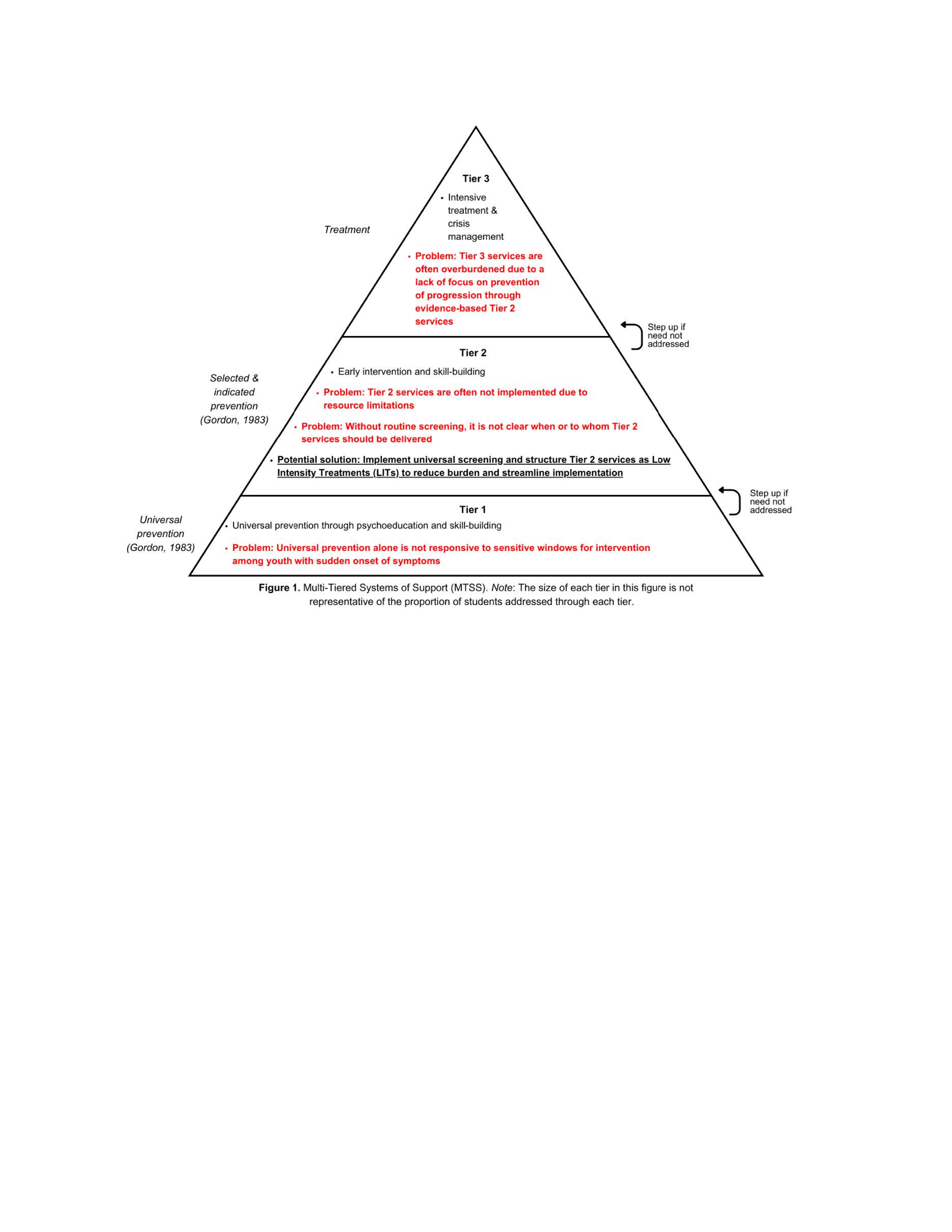
In summary, schools are facing problems such as:
- Not having rigorous or routine methods to identify students who need help, and limited monitoring of symptom change over time.
- Only having enough resources to help students with crisis-level concerns, leaving students with mild or moderate concerns with little to no support.
- Limited evidence-based light-touch prevention or intervention programs to address mild concerns.
To address these problems and improve school-based mental health we must:
- Implement universal screening on a regular basis.
- Provide low-intensity treatments as an option for students who could benefit from support but do not yet require intensive services.
- Develop pipelines to connect students with severe symptoms to clinical support and evaluate the best approach to partner mental and school systems.
Screening, Brief Intervention, and Referral to Treatment (SBIRT): Expanding from substance use to mental health broadly
The SBIRT model could effectively address the problems outlined above. SBIRT is an evidence-based approach to addressing substance use problems among youth at scale. The first component involves regular Screening to identify youth at risk. The second component involves providing evidence-based Brief Interventions to address moderate concerns and prevent them from worsening. The third component involves Referral to Treatment for youth who need more intensive care. SBIRT has historically been used in primary care settings and is increasingly being implemented in schools. However, to date, SBIRT in schools has primarily focused on substance use concerns. We argue that SBIRT could be integrated to include both substance use and other mental health concerns. The table below describes considerations for expanding SBIRT for transdiagnostic purposes. This integrated model would facilitate schools’ ability to identify students who could benefit from care and triage them to appropriate care. Offering students Brief Interventions may help to reduce burden on school providers, improve access to care, and address symptoms early and before they progress into more severe clinical presentations. In our paper, we examine each component of SBIRT in depth and discuss how it can be effectively delivered within an MTSS infrastructure.
| Table 1. Summary of Considerations for SBIRT in Schools | |||
| Screening | Brief Intervention | Referral to Treatment | |
| Original Goal | Screen for substance use and categorize by degree of risk to triage. | Reduce, delay, or prevent substance use through psychoeducation, motivational interviewing, contingency management, etc.
|
Intervene on risky and/or clinical levels of substance use. |
| Expanded Goal | Offer integrated emotional, psychological, and behavioral screeners that assess for substance use and comorbid mental health conditions. Triage to one or multiple BI or RT options based on symptom profile. | Treat comorbid substance use and other mental health problems directly and indirectly by the reduction of symptoms across problem categories.
|
Provide mental health support tailored to endorsed mental health symptoms above a clinical threshold, across a spectrum of symptoms. |
| Key Considerations | ● Frequency of screening
● Screener length/content ● Screener thresholds for referral/definitions of risk ● Updating screening instruments based on new data ● Confidentiality
|
● Resources available to implement brief interventions
● Availability of a range of brief interventions (very low-intensity to more intensive) ● Combination of BI with more intensive treatments ● BI as a universal support strategy |
● Available referral sources (peers, community providers, school personnel, etc)
● Follow-up care and symptom monitoring ● Tracking engagement with the referred treatment ● Coordination between school and mental health systems |
Next steps: Test implementation success
To bring the promise of an integrated SBIRT model to fruition in schools, thoughtful planning for implementation is critical. Implementation science frameworks such as RE-AIM (Reach, Effectiveness, Adoption, Implementation, & Maintenance) can help to organize efforts for implementation and guide future research endeavors.
| Table 2. Sample Recommended RE-AIM Outcomes for Assessing Implementation of Integrated SBIRT in Schools | |||
| Screening | Brief Intervention (BI) | Referral to Treatment | |
| Reach | ● Proportion of students screened
● Representative capture of students across identity groups ● Feasibility and acceptability of screeners according to adolescents |
● Proportion of students receiving Tier 1 BIs
● Proportion of students referred to Tier 2 BIs ● Proportion of students who were referred to Tier 2 BIs and completed them ● Degree to which proportions are consistent across demographic groups |
● Percent of students screened recommended for further treatment
● Evaluation of thresholds (i.e., should higher or lower thresholds be considered) ● Rate of engagement with referred treatment |
| Effectiveness | ● Validity of screeners in schools, by school-based or other personnel, and with adolescents of various ages
● Iterative improvement of screeners to balance efficiency and accuracy |
● Transdiagnostic mental health outcomes
● Motivation to engage in additional services ● Perceived autonomy supported by SBIRT implementation structure and procedures ● Uptake of additional services ● Degree to which effectiveness is consistent across demographic groups |
● Mental health outcomes as a result of school-based, peer, and community-based referrals
● Evaluation of supports needed to encourage engagement with treatment |
| Adoption | ● Supports and finances needed to facilitate broad screening and follow-up
● Amount of potential follow-up treatment needed to include certain screeners ● Understanding of which system members need to be involved in screener planning and implementation |
● Mixed-methods evaluations of acceptability of BIs
● The degree to which acceptability is consistent across demographic groups ● Student mental health autonomy (selecting between multiple possible interventions) |
● Assessment of school and mental health provider need to encourage communication and collaboration
● Improved understanding of adolescent perception of clinical care |
| Implementation | ● Direct evaluation of schools’ resource need assessment (e.g., time, personnel, prepared screening instruments, confidentiality) to allow for coordinated screeners that preserve adolescents’ privacy | ● Fidelity of BIs as measured by coders or a fidelity scale | ● Investigation into the gaps in mental health care for adolescents
● Understanding the needs of schools and providers to coordinate care |
| Maintenance | ● Evaluation of mental health trajectories, sensitive periods, and timing of screeners
● Investigation into timing, spacing, and limitations of regular screening among adolescents in schools (from both student and system perspectives) |
● Return rates for BIs that are available on a rolling basis and the degree to which return rates are consistent across demographic groups | ● Ongoing evaluation of new treatment modalities and incorporation into schools
● Evaluate rates of use of referral lists and how to present escalation of care to adolescents ● Assessment of care liaisons and the role of stepped care in schools |
Conclusion
The Screening, Brief Intervention, and Referral to Treatment (SBIRT) framework has major potential to address the youth mental health crisis if we can successfully adapt and incorporate a transdiagnostic SBIRT approach into existing school structures. To learn more about SBIRT and how it can be successfully implemented in schools, read the full paper here.
DISCUSSION QUESTIONS
- How might SBIRT be adapted to fit within the realities of school budgets, staffing, and competing demands on educators?
- What are the trade-offs between focusing on intensive, individualized treatment versus scalable, population-oriented approaches in schools?
- What role do clinical psychologists have to play in partnering with schools, researchers, and communities looking to develop scalable, population level solutions to these population health problems?
ABOUT THE AUTHORS


REFERENCES CITED
No references beyond the Cohen*, Costello*, et al. (in press) paper that this blog post is based on.