
2026 Digital Poster Submissions
Are Grandiose Manipulative Traits a Useful Specifier for ODD – Evidence from Personality Peer and Antisocial Outcomes
Jenson J. Avellán, B.S. Harriet R. DeGroot, M.A. Nicholas A. Bellamy, M.A. Randall T. Salekin, Ph.D.
Behavioral Treatments for Insomnia Comorbid with Depression in Middle-aged to Older Adults
Jong (Jessica) Kim, B.A., Amy Fiske, PhD, CBSM
Correlates of Identity Diffusion in Patients with Borderline Personality Disorder
Dasi Vann, Emily Scoufis and Feihong Wang, Ph.D.
Detecting the Differential Placebo Produced by rTMS for PTSD 1
Carsten Torgeson, Emily Kuhen
Longitudinal Associations Between PTSD Symptoms, Suicide Bereavement and Suicidal Ideation Among U.S. Military Personnel
Athena B. Thai, B.A., Tyler B. Rice, B.S., Thomas E. Joiner, Ph.D.
Predictive Associations Between ADHD-Associated BFI Traits in Adolescent Girls and Self-Esteem by Emerging Adulthood
Hannah Yang, Stephen P. Hinshaw
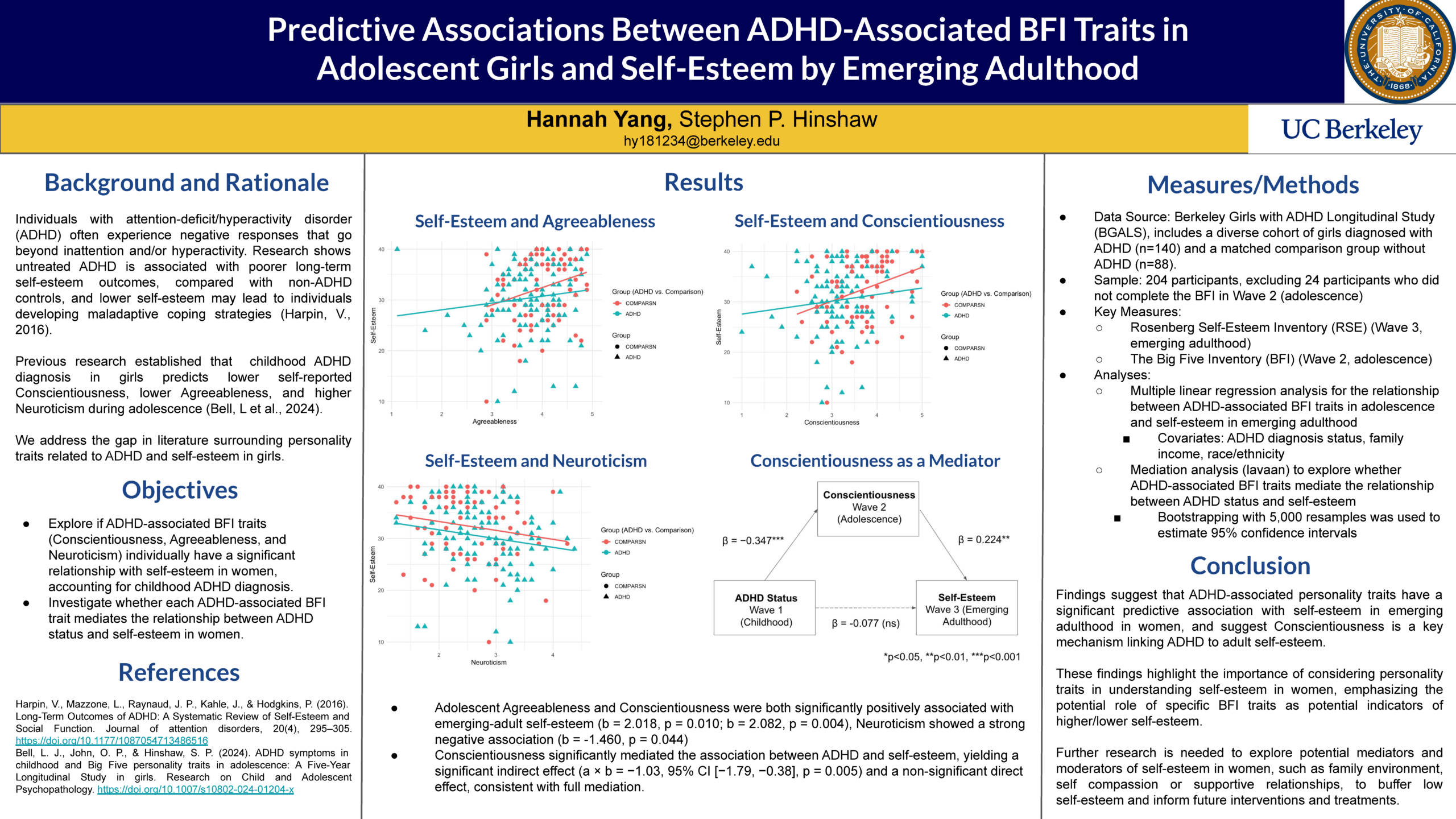
Individuals with attention-deficit/hyperactivity disorder (ADHD), a neurodevelopmental condition characterized by symptoms of inattention and hyperactivity/impulsivity, often experience negative responses that can lead to adverse outcomes, exemplified in untreated ADHD being associated with poorer long-term self-esteem and social function outcomes compared to non-ADHD controls (Harpin, V., 2016). Previous research has established childhood ADHD diagnosis in girls predicts lower self reported Conscientiousness, lower Agreeableness, and higher Neuroticism during adolescence (Bell, L et al., 2024). With this knowledge, our study explores how personality traits related to ADHD are linked to self-esteem in a longitudinal sample of girls from the Berkeley Girls with ADHD Longitudinal Study (BGALS).
The main questions we aim to answer are as follows: 1) Do ADHD-associated Big Five Inventory (BFI) traits (Conscientiousness, Agreeableness, and Neuroticism) individually predict self-esteem by adulthood, accounting for childhood ADHD diagnosis? (2) Does each ADHD-associated BFI trait (Conscientiousness, Agreeableness, and Neuroticism) mediate the relationship between ADHD status and self-esteem in women? We hypothesize that high Conscientiousness and high Agreeableness will predict higher self-esteem whereas high Neuroticism will predict lower self-esteem in women, accounting for ADHD diagnosis. We also hypothesize that each trait will significantly mediate the relationship between ADHD status and self-esteem in women. That is, we expect childhood ADHD to predict lower Conscientiousness, lower Agreeableness, and higher Neuroticism, which in turn would be associated with lower self-esteem.
Data emanate from the Berkeley Girls with ADHD Longitudinal Study (BGALS), which includes a diverse cohort of girls diagnosed with ADHD (n=140) and a matched comparison group without ADHD (n=88). They were ascertained at ages 6-12 years and followed across subsequent waves of data collection. The total sample is 228 girls, but our sample excludes 24 participants who did not complete the BFI in Wave 2 (adolescence), so N = 204. Key measures include the Rosenberg Self-Esteem Inventory (RSE) measured in Wave 3 (emerging adulthood), and the Big Five Inventory (BFI) measured in Wave 2 (adolescence).
Multiple linear regression analysis was conducted to examine the association between ADHD-associated BFI traits in adolescence, and self-esteem in emerging adulthood. Childhood ADHD diagnosis was the key covariate, alongside other covariates: family income and race/ethnicity. Agreeableness and Conscientiousness were both significantly positively associated with self-esteem (b = 2.018, p = 0.010; b = 2.082, p = 0.004) while Neuroticism showed a strong negative association (b = -1.460, p = 0.044), consistent with our hypotheses about traits and self-esteem. Mediation analysis was performed to determine whetherADHD-associated BFI traits mediated the relationship between ADHD status and self-esteem. Only Conscientiousness significantly mediated the association between ADHD and self-esteem, yielding a significant indirect effect (a × b = −1.03, 95% CI [−1.79, −0.38], p = 0.005) and a non-significant direct effect, suggesting full mediation.
These findings highlight the importance of considering ADHD-related personality traits in understanding the development of self-esteem in women. Further research on potential mediators and moderators of self-esteem in women can inform future assessments and preventive efforts.
Sexual and other taboo obsessions are frequently disclosed in an anonymous online OCD community
Shreya Singhvi
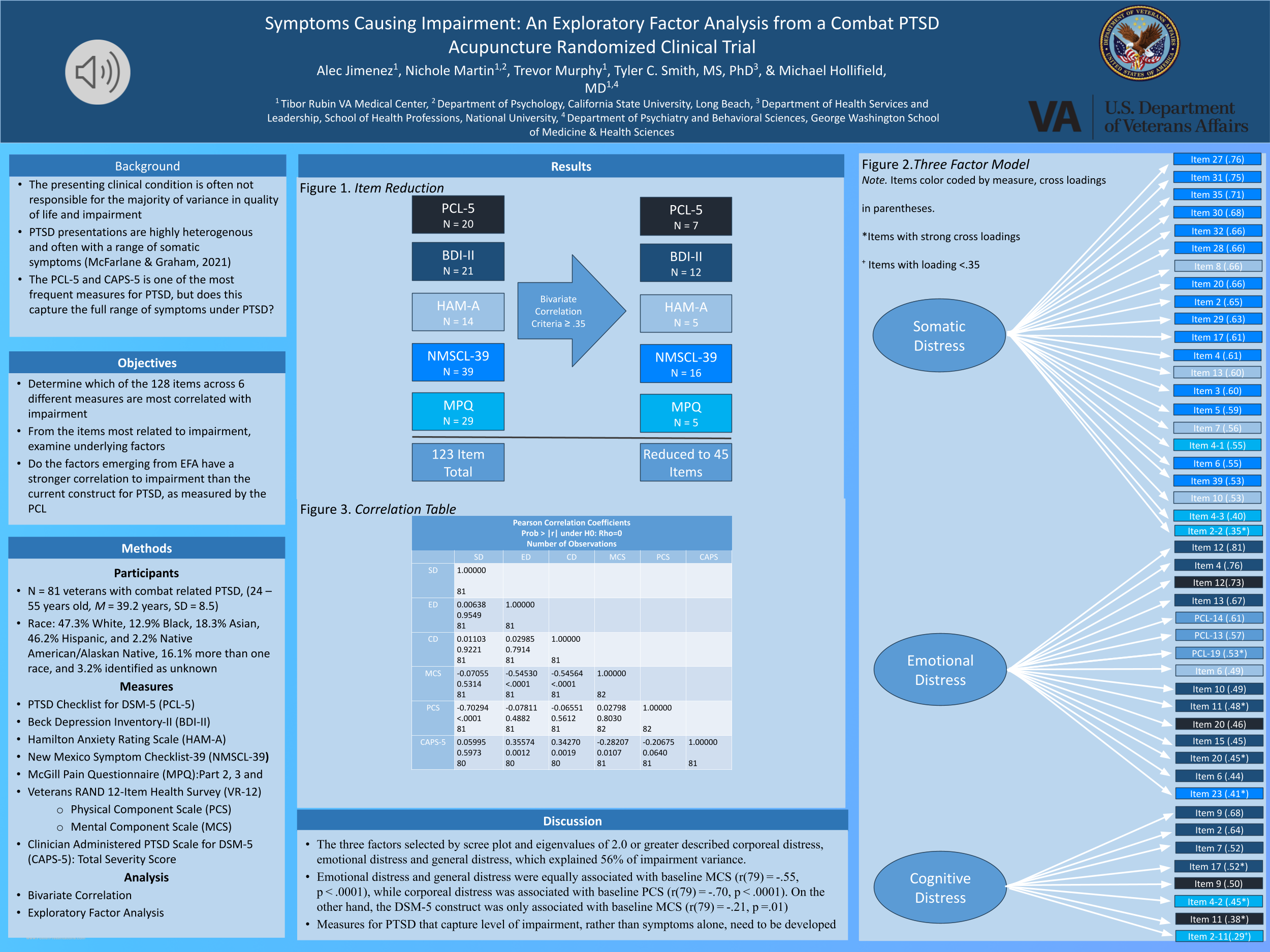
Symptoms Causing Impairment An Exploratory Factor Analysis from a Combat PTSD Acupuncture Randomized Clinical Trial
Alec Jimenez, Nichole Martin, Travor Murphy, Tyler C. Smith, MS, PHD, & Michael Hollifield, MD
Systemic Review and Meta-Analysis of Emotion Regulation and Coping Among Black-African American Youth
Chenelle Miller, MA, Tanya Sharma, MA, & Amy Hyoeun Lee, PhD
Thank you to our sponsors
Premier Sponsors

Champion Sponsors

Collaborator Sponsors

Pearson

Supporter Sponsors

Get in touch
You have questions, we have answers. How can we help?